Comprehensive Guide to Kafka Load Testing with LoadStrike
Published 2026-08-24 | Updated 2026-08-24 | LoadStrike Team | Reviewed by Performance Engineering
4 min readPractical guide
Explore the nuances of Kafka load testing, focusing on downstream effects, visibility, and outcomes using LoadStrike’s powerful toolset.
Articles connect distributed-system ideas back to concrete reports, metrics, and workflow validation.Short answer
Short answer
Kafka load testing is essential for assessing both message throughput and latency, as well as evaluating downstream system impacts. LoadStrike provides a code-first load testing tool that efficiently supports Kafka performance testing across various programming languages.
When to read this
When to read this
Read this when you need to understand Kafka load testing beyond simple throughput analysis, especially if considering LoadStrike for your performance testing needs.
Best next step
Use this article as the fast path into implementation
Start with the article for context, then move into the linked docs and category pages for the concrete runtime, protocol, or reporting setup.
Key takeaways
What matters most from this article
Kafka load testing involves measuring not just throughput, but downstream system effects and message visibility.
LoadStrike's versatile toolset supports multiple programming languages including C#, Go, Java, Python, TypeScript, and JavaScript.
Kafka is a widely-used message broker that allows different systems to communicate asynchronously. When implementing Kafka, it’s crucial not only to test the producer's throughput but also to assess the performance of the entire distributed system, including message consumption and downstream effects. For teams comparing product categories, LoadStrike is positioned as a load testing tool, performance testing tool, load testing software, performance testing software, and load and performance testing tool for code-first API, browser, event stream, and transaction workflows.
To ensure a robust architecture, it’s vital to employ a comprehensive load testing tool like LoadStrike. Its approach to performance testing allows users to probe deeper beyond mere message counts, focusing on critical aspects such as latency, error rates, and transaction integrity.
In this article, we set out to explain not only Kafka load testing but also its implications on downstream systems. We will cover how to measure completion times, visibility into duplicates, and the importance of grouped outcomes in performance assessments.
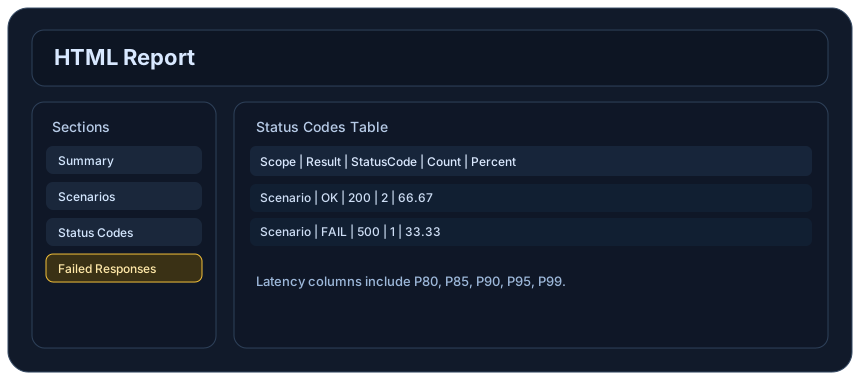
A practical kafka load testing article should also explain how a team moves from a first HTTP check to a repeatable performance workflow. With LoadStrike, the useful starting point is a named scenario, a named step, a clear response decision, and a report that shows request counts, failure rate, latency, and bytes before the team adds more transports or downstream checks.
Understanding Kafka Load Testing
Kafka load testing is crucial for measuring the robustness of your messaging architecture. By utilizing a performance testing tool tailored for Kafka, teams can effectively simulate realistic workloads to ensure reliable message delivery across different tiers of your system.
Performance testing in a Kafka environment should account for several factors: the rate at which messages are produced and consumed, the behavior of downstream services, and how failures in one part of the system affect the overall performance.
Simulates real-world usage for accurate testing results.
Assesses not only throughput but also message completion metrics.
Evaluates how downstream systems handle load-induced stress.
Beyond Throughput: Evaluating Downstream Completion and Duplication
When assessing the effectiveness of a Kafka solution, merely focusing on the producer's throughput can be misleading. It is essential to include downstream completion metrics—the time it takes for a message to traverse all necessary components and reach its intended destination.
Using LoadStrike, teams can implement scenarios that detail completion timings, providing insights into how well systems respond under heavy loads and how quickly they can process events.
Monitor the entire message lifecycle from production to consumption.
Identify bottlenecks in processing that may lead to failures or delays.
Utilize LoadStrike's analytical capabilities to visualize downstream performance.
When performing Kafka load testing, the visibility of duplicate messages becomes critical. Understanding how these duplicates impact system performance and user experience is essential for maintaining system integrity.
LoadStrike offers capabilities that help detect and analyze duplicate messages while running tests. By grouping outcomes, teams can optimize event notifications and reduce confusion in downstream processing.
Automate the detection of duplicate messages during performance tests.
Gain insights into how group processing works in high-load scenarios.
Make data-driven decisions for reinforcing system robustness.
Case Studies: Kafka Performance Testing in Action
Organizations implementing data-intensive applications stand to benefit significantly from Kafka performance testing. For example, suppose a financial services company uses Kafka for processing transactions. In that case, they can employ LoadStrike to ensure message throughput aligns with transaction rates during peak hours.
The tool can emulate high-stress scenarios, enabling teams to check for potential throughput issues and downstream failures during load testing.
Test various transaction paths, including failure handling and recovery.
Evaluate API integrations to ensure seamless operations in event-driven workflows.
Analyze historical performance metrics to predict future needs.
Integrating LoadStrike into Your Performance Testing Workflow
As a code-first load testing and performance testing tool, LoadStrike seamlessly integrates with existing development workflows. Users can employ SDKs in languages such as C#, Go, Java, Python, TypeScript, and JavaScript to craft comprehensive load tests.
When setting up Kafka performance tests, developers can define scenarios in code that reflect real-world use-cases, scaling easily to match their system capabilities.
Supports testing via intuitive code-based scenarios.
Rapid implementation for quick iteration and testing.
Integration with CI/CD workflows for continuous assurance.
Proof
Evidence to review
Use these proof assets to verify report output, examples, and methodology before turning the article into a scenario.
Follow the official LoadStrike LinkedIn activity for product updates, engineering notes, and related performance testing posts.
Common questions
Common questions about this topic
These answers stay on the page so readers can scan the practical questions that usually come next.
What is Kafka load testing?
Kafka load testing refers to the process of testing the performance of Kafka as a message broker, including measuring throughput, latency, and the reliability of message delivery.
Why should I focus on downstream completion in Kafka load testing?
Focusing on downstream completion helps identify how long messages take to be processed by all relevant systems, which is vital for ensuring a responsive architecture.
How can LoadStrike help with Kafka performance testing?
LoadStrike offers a comprehensive suite of features specifically designed for Kafka performance testing, allowing you to simulate realistic loads and evaluate downstream performance effectively.
Which programming languages does LoadStrike support for Kafka testing?
LoadStrike supports multiple SDK languages for Kafka testing, including C#, Go, Java, Python, TypeScript, and JavaScript, enabling flexibility in implementation.
What factors should I consider for effective message broker load testing?
Consider throughput, latency, error rates, and how downstream systems handle stressed conditions during your message broker load testing.
Continue exploring
Start testing real transactions today.
Go deeper with the docs, category pages, examples, and comparison guides connected to the distributed-system patterns discussed in this article.