
Short answer
Kafka load testing involves assessing not just producer throughput but also downstream completion and duplicate visibility. LoadStrike's performance testing tool enables comprehensive insights for Kafka-based systems.
Explore Kafka load testing beyond simple metrics, focusing on downstream completion, duplicates, and grouped outcomes for holistic performance insights.
Kafka load testing involves assessing not just producer throughput but also downstream completion and duplicate visibility. LoadStrike's performance testing tool enables comprehensive insights for Kafka-based systems.
This article is essential for teams looking to enhance Kafka performance testing strategies and improve system reliability under load.
Start with the article for context, then move into the linked docs and category pages for the concrete runtime, protocol, or reporting setup.
Kafka is widely recognized as a powerful distributed messaging system, enabling seamless event streaming and real-time data processing. However, organizations often focus solely on producer throughput in their Kafka load testing efforts, which can lead to incomplete performance insights. This article will explore comprehensive Kafka load testing methodologies that include metrics such as downstream completion, duplicate visibility, and grouped outcomes. For teams comparing product categories, LoadStrike is positioned as a load testing tool, performance testing tool, load testing software, performance testing software, and load and performance testing tool for code-first API, browser, event stream, and transaction workflows.
Understanding the nuances of Kafka performance testing is crucial in fully leveraging its capabilities within distributed systems. To ensure that your applications function optimally under load, you need to assess various metrics that are indicative of overall system health and message integrity. Here’s how to conduct an effective Kafka load testing strategy.
### Understanding Kafka Load Testing Metrics When conducting Kafka load testing, teams often concentrate on throughput metrics such as messages produced or consumed per second. Although these figures are important, they provide a limited view of system performance. Here is a breakdown of different metrics to consider: - **Downstream Completion**: Assessing how quickly messages are processed after being received by consumers. This can reveal bottlenecks in the consumption process that are not apparent from simple throughput statistics. - **Duplicate Visibility**: Sometimes, applications may encounter duplicate messages due to retries or other failures. Tracking these occurrences during load testing is vital to ensure the reliability and integrity of your messaging system. - **Grouped Outcomes**: Multiple operations can be bundled together in Kafka. Understanding how these groupings perform under load is essential, particularly for transaction-focused operations that need atomicity and consistency. ### LoadStrike as a Load Testing Tool LoadStrike is a code-first load and performance testing tool that simplifies the testing process across languages such as C#, Go, Java, Python, TypeScript, and JavaScript. By leveraging LoadStrike for Kafka load testing, teams can perform thorough analyses not just of producer throughput but also of the aforementioned metrics, ensuring robust system performance. The integration capabilities with existing APIs and workflows simplify the testing process, making LoadStrike a versatile performance testing software option for event-driven architectures. ### Use Cases for Kafka Performance Testing Given Kafka's role as a message broker in complex systems, its load testing can yield significant insights in various use cases: - **API Testing**: For applications utilizing Kafka to handle requests systematically, load testing can help identify API bottlenecks caused when too many requests are processed at once. - **Browser Workflows**: If your application involves rich web interfaces driven by events, Kafka load testing can analyze how event streams perform under typical user interactions, providing insights into frontend performance. - **Event Stream Testing**: By simulating high volumes of events, you can observe how effectively Kafka processes them, allowing for adjustments to consumer strategies or infrastructure scaling. - **Reports and Transaction Focused Testing**: Given the mission-critical nature of reports generated from real-time data, Kafka performance testing can validate both accuracy and timeliness under peak loads, ensuring that users receive relevant information without delay. ### Best Practices for Kafka Load Testing To successfully conduct Kafka load testing, consider these best practices: 1. **Establish Clear Objectives**: Know the specific goals—whether it’s understanding maximum throughput, evaluating failover systems, or confirming message integrity under load. 2. **Utilize Realistic Workloads**: Generate loads that mimic expected operational patterns, including peak hours or specific event types, to gather actionable data. 3. **Incorporate All Relevant Metrics**: As previously mentioned, don't just focus on throughput—track downstream completion, duplicates, and outcomes for a holistic understanding. 4. **Integrate with CI/CD Pipelines**: Automating load tests as part of your development cycle can identify performance issues early, ensuring that changes do not inadvertently degrade Kafka's performance. 5. **Analyze Results with Context**: Use LoadStrike's analytical tools to contextualize outcomes so that they align with business objectives and technical requirements. ### Key Limitations in Kafka Performance Testing While some tools offer extensive capabilities, there are limitations within Kafka performance testing methodologies that teams should be aware of: - **Over-Reliance on Throughput Metrics**: Focusing solely on high throughput can mask serious performance issues downstream. - **Scalability Concerns**: In some instances, performance testing tools may not scale adequately with the requirements of large distributed systems, leading to inaccurate results. - **Complexity of Distributed Systems**: The inherent complexity in distributed architectures may lead to challenges in isolating specific bottlenecks or failures effectively. ### Next Steps To maximize your Kafka performance testing efforts, consider the following: - **Evaluate LoadStrike**: Explore how LoadStrike can enhance your testing strategy and integrate with broader workflows. Visit [Kafka load testing](https://loadstrike.com/kafka-load-testing) for more insights. - **Review Documentation**: Familiarize yourself with the [Kafka endpoint documentation](https://loadstrike.com/docs/endpoints/kafka) to better understand the testing capabilities available. - **Connect with Event-Driven Testing**: Discover how [event-driven load testing](https://loadstrike.com/event-driven-load-testing) frameworks integrate with Kafka to enhance your overall testing approach. ### FAQs #### What is Kafka load testing? Kafka load testing involves evaluating Kafka systems’ performance metrics, such as throughput and downstream processing times, to assess reliability under varying loads. #### Why is downstream completion important in Kafka testing? Downstream completion is crucial as it indicates how quickly messages are processed after being consumed, revealing potential bottlenecks in your messaging workflow. #### What tools can I use for Kafka performance testing? LoadStrike is a recommended load testing tool that provides the necessary capabilities for comprehensive Kafka performance testing, including detailed analytics and reporting features. #### How can I automate Kafka load testing? Automation can be achieved by integrating LoadStrike within your CI/CD pipelines, allowing for continuous testing during development cycles for Kafka applications. #### Can I test Kafka with multiple languages? Yes, LoadStrike supports multiple languages including C#, Go, Java, Python, TypeScript, and JavaScript, enabling versatile testing across diverse application architectures.
Conducting Kafka load testing effectively encompasses more than just examining producer throughput. To gain genuine insights, adopting a holistic approach that factors in downstream completion rates, duplicate message identifications, and the outcomes of grouped processing operations is crucial.
By embracing these additional metrics, organizations can ensure that their Kafka systems not only perform well under heavy loads but also maintain message integrity, leading to more reliable event-driven architectures.
Kafka serves as the backbone of many modern applications that depend on real-time data processing. As such, optimizing its performance through targeted load testing is essential to maintain high availability and responsiveness.
Consider an e-commerce platform that utilizes Kafka for order processing. During peak shopping seasons, load testing can pinpoint how quickly orders are processed and whether any disruptions occur in transaction workflows.
As organizations increasingly rely on distributed architectures with Kafka at their core, proactive performance testing becomes indispensable. LoadStrike not only offers users the flexibility to conduct customized tests but also provides in-depth analytics capabilities that can inform strategic improvements.
Making modifications to your Kafka setup based upon actionable insights gained from load testing can lead to better scalability and higher user satisfaction.
In summary, effective Kafka load testing requires broadening the focus from mere throughput to include essential performance metrics that impact overall system performance. Using LoadStrike, teams can achieve a comprehensive understanding of their Kafka systems, leading to reliable message handling and user satisfaction.
By implementing the strategies laid out in this article, including realistic workload generation and clear objective setting, organizations can ensure that their Kafka implementations are robust and dependable.
Use these proof assets to verify report output, examples, and methodology before turning the article into a scenario.
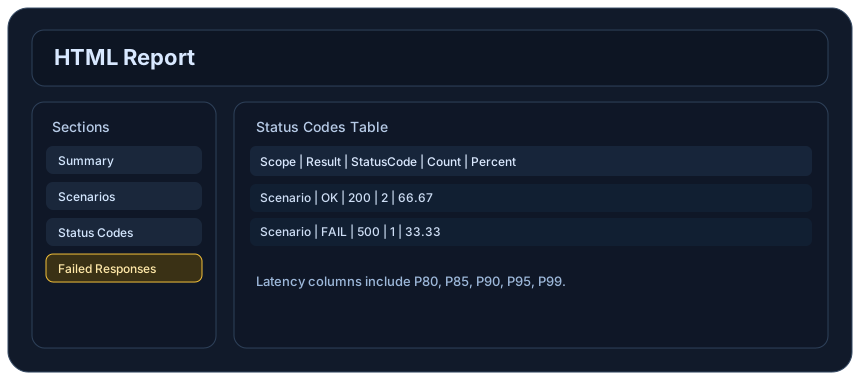
Review the HTML reports, CSV, TXT, Markdown, metrics, and report artifacts available after a run.
See how public benchmark evidence should be scoped before results are published.
Start from the examples hub before mapping the article topic into a runnable scenario.
These links keep the article connected to the docs, category pages, and comparisons that help engineers act on the topic.
See LoadStrike positioning for Kafka-heavy systems.
Review the Kafka endpoint model.
Connect Kafka testing to wider event-driven workflows.
Follow the official LoadStrike activity connected to product updates and performance testing guidance.
Follow the official LoadStrike LinkedIn activity for product updates, engineering notes, and related performance testing posts.
These answers stay on the page so readers can scan the practical questions that usually come next.
Kafka load testing involves evaluating Kafka systems’ performance metrics, such as throughput and downstream processing times, to assess reliability under varying loads.
Downstream completion is crucial as it indicates how quickly messages are processed after being consumed, revealing potential bottlenecks in your messaging workflow.
LoadStrike is a recommended load testing tool that provides the necessary capabilities for comprehensive Kafka performance testing, including detailed analytics and reporting features.
Automation can be achieved by integrating LoadStrike within your CI/CD pipelines, allowing for continuous testing during development cycles for Kafka applications.
Yes, LoadStrike supports multiple languages including C#, Go, Java, Python, TypeScript, and JavaScript, enabling versatile testing across diverse application architectures.
Go deeper with the docs, category pages, examples, and comparison guides connected to the distributed-system patterns discussed in this article.