
Free, Pro, and Enterprise all stay self-hosted.
Pricing
Flat self-hosted pricing.
Run LoadStrike on your own infrastructure. Start with Free or a 14-day Pro trial, then choose the plan that fits your runtime, transport, reporting, and rollout needs.
Self-hosted runtime
No cloud usage meter
License-based access
Predictable monthly cost
Regional currency when available
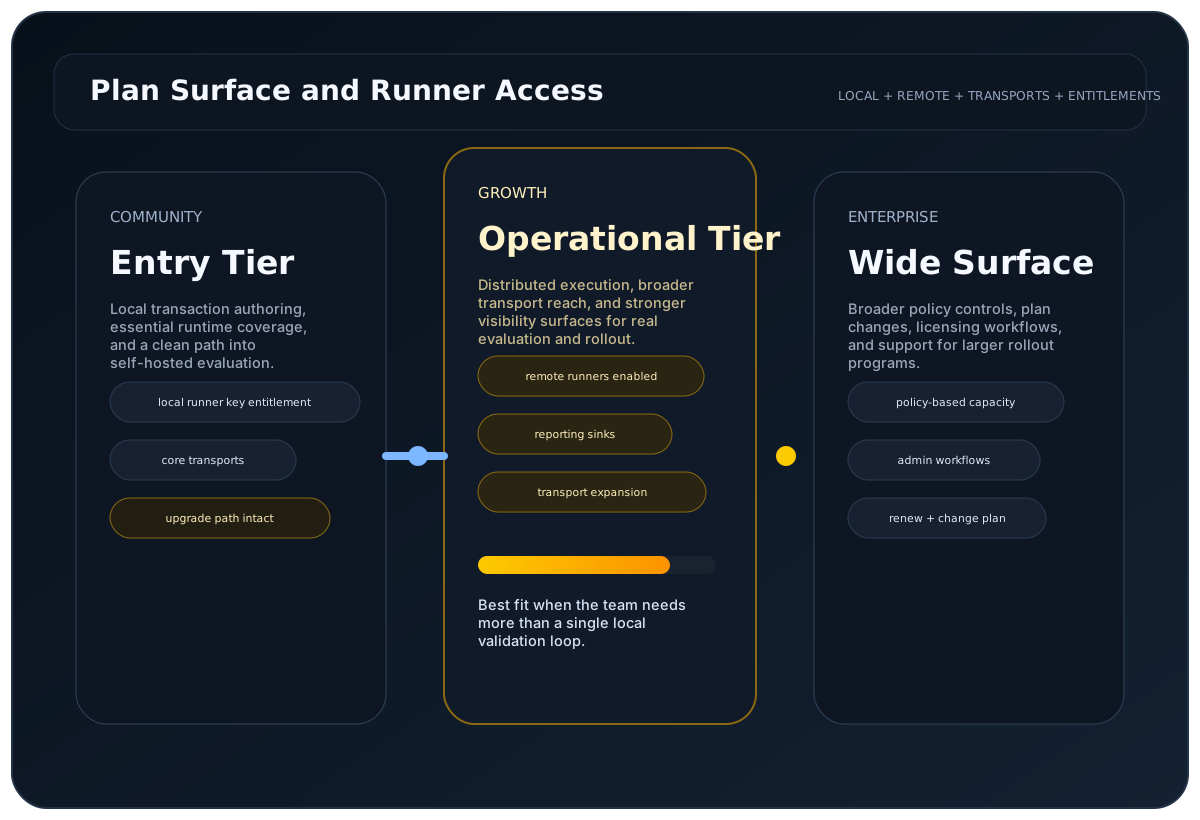
Free is included automatically for verified accounts.
Yearly billing lowers cost without changing plan access.
Eligible accounts can try LoadStrike before choosing a paid plan.
Choose a plan for the runtime features you need. No cloud usage meter.
Your bill follows the plan, not request volume.
All plans keep the same scenario and step model.
Start here
14-day Pro Trial
Use the trial to validate one real transaction before rollout.
No payment required
14-day Pro Trial
Use LoadStrike for 14 days with the same runtime capabilities as the Pro plan before you buy, for accounts with no prior paid license history.
Trial Free /14 days
- No payment required to start
- Same runtime capabilities as the Pro plan
- Single-license trial for one account
- Self-hosted runtime access for evaluation
- Started directly by the signed-in account holder
- Available only before an account has any paid license history
- Expires automatically after 14 days
Plans
Self-hosted pricing
Choose the runtime features you need. Free has no billing; Pro and Enterprise are plan-based.
Free
Free access for first HTTP checks.
Best for: Individual engineers validating basic HTTP performance workloads at no cost.
Included Free /no billing
Automatically issued after account verification.
- Scenario, step, and simulation runtime
- HTTP endpoint adapter
- HTML, CSV, TXT, and Markdown reports
- Scenario targeting and scenario completion timeout controls
- One Free license per account and device
- 6 monthly usage hours
- 5-minute minimum usage per run
- Unchanged retries using the returned session ID consume monthly usage once
Early bird
Pro
Adds broader transports, workload mix, and quality gates.
Best for: Engineering teams running broader transport, quality, and workload-mix coverage.
Early bird pricing
Monthly $399.00 $299.00 /month
Yearly $4,788.00 $3,229.20 /year
Annual discount: 10.00%
- Includes all Free features without Free usage limits
- Kafka, RabbitMQ, NATS, Redis Streams, AWS SQS, Azure Event Hubs, Push Diffusion, and delegate stream endpoints
- Cross-platform tracking selectors and source-only reporting
- Grouped correlation summary via GatherByField
- Redis-backed correlation store
- Trace-To-Test Autopilot starter generation
- Traffic Mix workload distribution across weighted scenario lanes
- Accessibility testing and browser Web Vitals helper scenarios
- Delegate-backed gRPC plus native or delegate-backed WebSocket Produce and Consume in every SDK
- One paid license for self-hosted execution
Enterprise
Adds portal reporting, sinks, plugins, clusters, and tailored rollout.
Best for: Quote-led configuration, tailored terms, and procurement-heavy rollout.
- Includes all Pro features
- Customer portal Run Reports with query-based scenario graphs and saved views
- Built-in reporting sinks for observability platforms, databases, message streams, file streaming, and webhooks
- Custom reporting sinks
- Custom worker plugins
- Runtime policy controls for agents, scenario counts, sinks, plugins, and cluster-command timeout ceilings
- Advanced threshold policy controls
- Advanced coordinator/agent targeting and cluster tuning controls
- Direct non-renewing Enterprise license issuance for administrator-managed provisioning
- Distributed execution capacity configured for enterprise needs
- Private portal checkout for exactly one agreed Enterprise amount at a fixed monthly or annual cadence
Plan fit
Match the plan to the rollout.
Pick based on feature needs and buying path.
Individual engineers validating basic HTTP performance workloads at no cost.
Engineering teams running broader transport, quality, and workload-mix coverage.
Quote-led configuration, tailored terms, and procurement-heavy rollout.
Feature comparison
See what changes by tier.
See which features unlock by tier.
| Feature | Free | Pro | Enterprise |
|---|---|---|---|
| Scenario runtime, steps, and load simulations | ✓ | ✓ | ✓ |
| Scenario targeting and scenario completion timeout controls | ✓ | ✓ | ✓ |
| HTTP endpoint adapter | ✓ | ✓ | ✓ |
| Report formats: HTML, CSV, TXT, Markdown | ✓ | ✓ | ✓ |
| License model | Automatic no-billing license | One self-serve paid license | Fixed-cadence private offer or direct non-renewing issue |
| Trace-To-Test Autopilot | — | ✓ | ✓ |
| Traffic Mix workload distribution | — | ✓ | ✓ |
| Accessibility testing and browser Web Vitals helper scenarios | — | ✓ | ✓ |
| Kafka endpoint adapter | — | ✓ | ✓ |
| RabbitMQ endpoint adapter | — | ✓ | ✓ |
| AWS SQS endpoint adapter | — | ✓ | ✓ |
| Azure Event Hubs endpoint adapter | — | ✓ | ✓ |
| NATS endpoint adapter | — | ✓ | ✓ |
| Redis Streams endpoint adapter | — | ✓ | ✓ |
| Push Diffusion and delegate stream endpoints | — | ✓ | ✓ |
| Delegate-backed gRPC plus native or delegate-backed WebSocket Produce and Consume | — | ✓ | ✓ |
| Cross-platform tracking selectors (header/json) | — | ✓ | ✓ |
| Source-only reporting (destination optional) | — | ✓ | ✓ |
| Grouped correlation summary via GatherByField | — | ✓ | ✓ |
| Redis-backed correlation store | — | ✓ | ✓ |
| Advanced threshold policy controls | — | ✓ | ✓ |
| Customer portal Run Reports | — | — | ✓ |
| Supported sinks: Prometheus Remote Write, CloudWatch, Dynatrace, New Relic, InfluxDB, TimescaleDB, Grafana Loki, Datadog, Splunk HEC, OTEL Collector, Elasticsearch, OpenSearch, Kafka, StatsD, DogStatsD, Netdata, JSONL, and GenericWebhook | — | — | ✓ |
| Custom reporting sinks | — | — | ✓ |
| Local dev cluster (coordinator + in-process agents) | — | — | ✓ |
| Distributed cluster using NATS | — | — | ✓ |
| Advanced coordinator/agent targeting and cluster tuning controls | — | — | ✓ |
| Custom worker plugins | — | — | ✓ |
| Runtime policy controls | — | — | ✓ |
Direct answer
How is LoadStrike priced?
LoadStrike uses simple self-hosted plans for teams that want predictable load testing costs today: Free, Pro, and Enterprise.
Start with Free or a Pro trial, then choose the plan that matches your transport, reporting, and rollout needs.
Public self-service pricing shows regional currency when a complete price is available. Private Enterprise accounts see the agreed amount and its fixed monthly or annual cadence in their assigned offer before checkout.
Common questions
Pricing questions teams ask before rollout
Short answers on pricing, rollout, and plan fit.
What changes between LoadStrike pricing plans?
Plans keep the same scenario model and unlock more transports, reports, extensibility, or rollout controls as the team moves from simple checks to wider performance programs.
Is LoadStrike priced for self-hosted use?
Yes. Pricing is plan-based for self-hosted use, so teams are not buying cloud load consumption each time they run a performance test from their own environment.
How does regional pricing work on the public page and in the portal?
The site shows regional currency when available, then keeps the account on the captured billing country so checkout, renewal context, and later portal views stay consistent. Checkout and recorded payments follow that currency's Stripe amount rules, including whole-unit charging for currencies that do not use fractional charge units.
How are plan changes billed?
Change Plan lists the paid subscription targets currently available for self-service changes. Any proration is shown before checkout. If no eligible target is available, the action stays unavailable.
What happens if live pricing is temporarily unavailable?
If live pricing is temporarily unavailable, LoadStrike uses the most recent complete pricing available and then the complete published fallback. If no complete price is available, the affected option stays unavailable; wait a moment and try again before checkout.
When can I renew a paid license?
Paid self-service renewal eligibility is based on the account's local calendar date, from two calendar months before through two calendar months after the license expiry date, inclusive.
How do renewals affect paid time?
Repeated or concurrent renewal requests produce one checkout and one license extension. A pending delayed payment leaves the current license unchanged. A later success extends it once only if the replacement remains eligible, then retires the prior subscription. A delayed older billing result cannot shorten or otherwise regress a newer renewal. If the replacement is ineligible, it grants no entitlement; the current license remains while the payment is reviewed, the replacement is cancelled, and a refund is completed when appropriate. A failed payment preserves the current license.
What should I do if a renewal checkout is already being created?
If a renewal request returns HTTP 409 with code renewal_checkout_in_progress and Retry-After: 2, no checkout URL is included. Wait two seconds, then retry the exact same renewal request. Keep retries bounded and contact support if the conflict continues.
What should I do if a checkout is already being created or recovered?
If a plan purchase, plan change, or private Enterprise checkout returns HTTP 409 with code billing_operation_in_progress and Retry-After: 2, no checkout URL is included. Wait two seconds, then retry the exact same request. Keep retries bounded and contact support if the conflict continues. If LoadStrike is recovering an interrupted checkout, that exact retry resumes the same checkout rather than creating a duplicate.
How do private Enterprise offers work?
Each new private Enterprise offer has exactly one administrator-selected amount and one fixed recurring cadence, monthly or annual. Approved accounts review those terms in the portal and continue to checkout using that cadence. An offer can have only one active checkout at a time, and it becomes available for another attempt if that checkout expires before payment. A payment completed after the offer is cancelled or expires does not grant an entitlement; the payment is reviewed, the subscription is cancelled, and a refund is completed when appropriate.
Can an administrator provision Enterprise without customer checkout?
Yes. An administrator can issue a non-renewing Enterprise license directly to an account for administrator-managed provisioning. Direct issuance creates neither a self-service Stripe subscription nor a private Enterprise offer.
Do all paid plans use the same scenario and reporting model?
Yes. The workflow model stays consistent across paid plans, while the available transports, reporting surfaces, extensions, and rollout controls change by the selected commercial plan.
Can a team evaluate LoadStrike before buying a paid plan?
Yes. Teams can use the trial path to validate LoadStrike on a real workflow before rollout, then choose the plan that matches their expected usage.
Choose a rollout path
Validate fit, then choose a plan.
Start with a quick run, review the report, then choose.