
Short answer
Event-driven load testing is crucial for microservices, requiring source-to-destination correlation and timeout handling. LoadStrike offers a code-first performance testing tool to facilitate these needs.
Explore why event-driven load testing is crucial for microservices, requiring source-to-destination correlation, timeout handling, and grouped reporting.
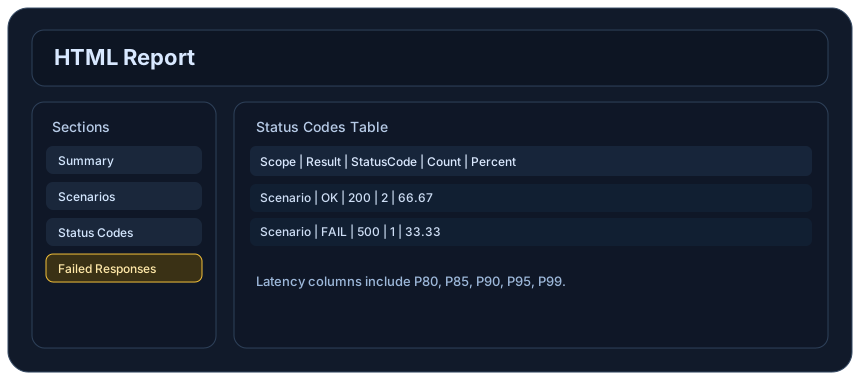
Event-driven load testing is crucial for microservices, requiring source-to-destination correlation and timeout handling. LoadStrike offers a code-first performance testing tool to facilitate these needs.
This article is best read when considering performance testing strategies for event-driven architectures or microservices deployments.
Start with the article for context, then move into the linked docs and category pages for the concrete runtime, protocol, or reporting setup.
In today's software landscape, microservices architecture has become a prevalent choice for building scalable applications. However, ensuring the performance of such distributed systems introduces unique challenges, particularly when it comes to event-driven load testing. Load and performance testing tools need to adapt to the complexities of microservices, ensuring that all components function together seamlessly. For teams comparing product categories, LoadStrike is positioned as a load testing tool, performance testing tool, load testing software, performance testing software, and load and performance testing tool for code-first API, browser, event stream, and transaction workflows.
Event-driven load testing focuses on how systems perform through asynchronous events, which are triggered by user actions or other system processes. This type of performance testing is essential as it mirrors real-world usage where services can communicate through message queues or event streams. Given the rise of technologies such as Kafka and RabbitMQ, adopting a load testing software that supports these patterns is critical.
A practical event-driven load testing article should also explain how a team moves from a first HTTP check to a repeatable performance workflow. With LoadStrike, the useful starting point is a named scenario, a named step, a clear response decision, and a report that shows request counts, failure rate, latency, and bytes before the team adds more transports or downstream checks.
Event-driven load testing assesses the performance and reliability of systems that react to events. These can be user-initiated actions, background processes, or messages from other services. Unlike traditional load testing, which may focus on synchronous requests, event-driven testing emphasizes the flow of data through complex asynchronous systems.
This testing method not only measures response times but also evaluates how effectively systems handle bursts of traffic and delays between events. For example, in a microservice architecture where one service queues messages to another, testing must ensure that messages are processed correctly under load.
While event-driven load testing is essential, it presents multiple challenges. One of the primary hurdles is source-to-destination correlation. In a microservices architecture, where multiple services might interact with one another through an event stream or message queues, tracking the flow of individual requests can become complex. This complexity necessitates load testing software that provides robust context to each transaction, associating results with the specific calls that initiated them.
Another critical aspect is timeout handling; asynchronous processing introduces scenarios where services may not respond within expected timeframes. A good load and performance testing tool should account for these timeouts, allowing testers to define thresholds and expectations.
LoadStrike stands out as a comprehensive code-first load testing and performance testing tool designed with microservices and event-driven architectures in mind. It supports multiple programming languages, including C#, Go, Java, Python, TypeScript, and JavaScript, ensuring that teams can seamlessly integrate their testing processes into existing workflows.
One of LoadStrike’s notable features is its ability to provide deep transaction visibility through source-to-destination tracing. This allows teams to generate detailed reports that clarify how services interact under load. Moreover, the tool has robust timeout handling capabilities, enabling users to configure appropriate limits to gauge the effectiveness of their system responses.
For example, consider an e-commerce platform utilizing microservices for its order processing. An event-driven load testing approach would simulate user behavior where an order placement triggers a sequence of events: inventory checks, order confirmations, and payment processing. By using LoadStrike, teams can monitor each of these actions and assess how delays or failures in one service affect the overall transaction flow.
Another use case involves testing APIs that communicate through message queues. Here, LoadStrike can create a performance testing environment that reflects real-world pressure on the services, allowing engineers to identify bottlenecks in processing requests and ensure the system scales accordingly.
Use these proof assets to verify report output, examples, and methodology before turning the article into a scenario.
Review the HTML reports, CSV, TXT, Markdown, metrics, and report artifacts available after a run.
See how public benchmark evidence should be scoped before results are published.
Start from the examples hub before mapping the article topic into a runnable scenario.
These links keep the article connected to the docs, category pages, and comparisons that help engineers act on the topic.
Understand async and broker-backed workflow coverage.
Learn the complete workflow model behind LoadStrike.
Read the core transaction definition.
Follow the official LoadStrike activity connected to product updates and performance testing guidance.
Follow the official LoadStrike LinkedIn activity for product updates, engineering notes, and related performance testing posts.
These answers stay on the page so readers can scan the practical questions that usually come next.
Event-driven load testing evaluates the performance of systems that operate asynchronously, relying on events triggered by user actions or other system processes.
LoadStrike provides tools to trace requests from their origin through multiple microservices, ensuring all transaction data is associated for accurate performance analysis.
LoadStrike supports various programming languages including C#, Go, Java, Python, TypeScript, and JavaScript.
Grouped reporting allows users to analyze related transactions together, making it easier to spot performance trends and issues in complex event-driven architectures.
Timeout handling is crucial in event-driven architectures as it helps manage asynchronous processes that may not respond in a timely manner, thereby preventing cascading failures.
Go deeper with the docs, category pages, examples, and comparison guides connected to the distributed-system patterns discussed in this article.