
Short answer
Load testing software like LoadStrike allows for comprehensive analysis of distributed systems, emphasizing code-first execution and transaction evidence, making it ideal for performance testing.
Discover how LoadStrike's load testing software can enhance distributed systems with code-first execution and detailed transaction evidence.
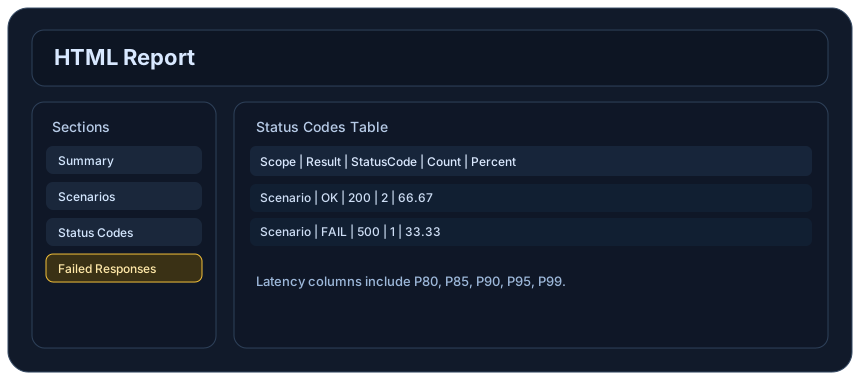
Load testing software like LoadStrike allows for comprehensive analysis of distributed systems, emphasizing code-first execution and transaction evidence, making it ideal for performance testing.
This article is useful for engineering, QA, and SRE teams who need effective strategies for load and performance testing of distributed systems.
Start with the article for context, then move into the linked docs and category pages for the concrete runtime, protocol, or reporting setup.
Load testing is crucial in ensuring your application performs well under expected traffic conditions. This is particularly important for distributed systems where traditional testing can fall short. LoadStrike stands out as a load testing software designed to meet the specific needs of these environments, focusing on code-first execution and transaction evidence, ensuring that every facet of performance is carefully analyzed. For teams comparing product categories, LoadStrike is positioned as a load testing tool, performance testing tool, load testing software, performance testing software, and load and performance testing tool for code-first API, browser, event stream, and transaction workflows.
### Why Load Testing Is Essential for Distributed Systems
Distributed systems, which consist of multiple interconnected services and nodes, require rigorous performance testing to maintain reliability under stress. Load testing software helps identify how systems behave when subjected to varying loads, ensuring scalability and stability before production deployment. Without proper load testing, applications risk downtime, decreased performance, and a poor user experience, particularly during peak traffic periods. During these times, transaction load testing can prove invaluable, pinpointing bottlenecks and inefficiencies throughout the system, from APIs to user workflows. Just as critical is the evidence of performance through detailed reporting, which LoadStrike excels at providing. This facilitates informed decisions to further optimize code and infrastructure, leading to enhanced reliability and user satisfaction. Although many load testing tools exist, few can match LoadStrike's capabilities for distributed systems, especially in transaction-focused scenarios. Despite other tools in the market, which may focus on either traditional execution or simplified interfaces, LoadStrike allows users to harness the full capabilities of their code to accurately simulate real-world scenarios. By employing a code-first approach, developers can easily script complex load tests that replicate actual usage patterns, particularly in event-driven architectures where timing and sequences can significantly impact performance. Furthermore, this approach integrates seamlessly with the supported SDK languages: C#, Java, Python, Go, TypeScript, and JavaScript, offering flexibility for diverse development teams. This versatility empowers teams to tailor tests specific to their architecture, ensuring true representation during performance evaluations.
LoadStrike provides several key features that set it apart from other load testing tools, particularly in the context of distributed systems. These features enable teams to run efficient load tests that provide valuable insights into their application’s performance.
### Code-First Execution: Every Detail Matters While many performance testing tools offer a GUI for test creation, LoadStrike’s code-first execution lets teams leverage existing code to create and customize load tests directly within their development environment. This means developers can define precise parameters for performance testing, ensuring accuracy in simulations.
LoadStrike's capabilities shine through various real-world applications across different types of testing, from APIs to user workflows. Here are some scenarios where LoadStrike delivers significant value:
### APIs Performance Testing: Understanding Limits In today's microservices architecture, APIs often serve as a frontend to multiple distributed systems. Using LoadStrike's load testing software, teams can simulate thousands of concurrent requests to ensure that their APIs can handle heavy traffic without degrading performance. Detailed reports provide insights on latency and response times, allowing developers to identify the breaking points in their API service.
For many organizations, self-hosted solutions offer more control and security over their testing environments. LoadStrike supports self-hosted load testing, allowing teams to perform tests on their infrastructure without exposing sensitive data. This is especially critical for companies in regulated industries where data privacy is paramount.
### Increased Security and Control The ability to conduct load testing on a self-hosted platform means internal teams can manage deployments, updates, and configurations. LoadStrike’s self-hosted load testing tool empowers organizations to run their assessments without third-party dependencies, providing peace of mind and compliance.
As your teams prepare for production deployments, considering the effectiveness of load testing should not be an afterthought. LoadStrike's suite of features specifically tailored for distributed systems ensures that performance testing remains accurate and meaningful.
### Emphasizing Transaction Load Testing LoadStrike’s focus on transaction load testing ensures that critical user transactions are monitored under load, providing your teams with the data required to make key operational decisions. The performance testing software bridges the gap between development and operations, facilitating more stable releases with minimized risks of performance degradation when tested against live traffic.
Use these proof assets to verify report output, examples, and methodology before turning the article into a scenario.
Review the HTML reports, CSV, TXT, Markdown, metrics, and report artifacts available after a run.
See how public benchmark evidence should be scoped before results are published.
Start from the examples hub before mapping the article topic into a runnable scenario.
These links keep the article connected to the docs, category pages, and comparisons that help engineers act on the topic.
Review load testing software fit.
Compare the wider tool landscape.
Review demand-shaping options.
Follow the official LoadStrike activity connected to product updates and performance testing guidance.
Follow the official LoadStrike LinkedIn activity for product updates, engineering notes, and related performance testing posts.
These answers stay on the page so readers can scan the practical questions that usually come next.
LoadStrike is ideal for distributed systems, particularly those utilizing APIs, event-driven architectures, or complex transactions requiring detailed load testing.
LoadStrike supports several popular SDK languages, including C#, Java, Python, Go, TypeScript, and JavaScript.
Yes, LoadStrike offers a self-hosted option that allows organizations to control their testing environment securely while preventing exposure of sensitive data.
LoadStrike allows you to define specific user transactions and assess their performance under load, providing detailed reports that highlight latency and error rates.
Yes, LoadStrike is designed to integrate seamlessly with existing CI/CD pipelines, ensuring smooth performance testing workflows.
Go deeper with the docs, category pages, examples, and comparison guides connected to the distributed-system patterns discussed in this article.