
Short answer
Load testing software is crucial for ensuring application performance under load. LoadStrike stands out as a code-first solution tailored for distributed systems, delivering precise transaction testing.
Discover LoadStrike, a leading load testing software designed for distributed systems where code-first execution and transaction verification are essential.
Load testing software is crucial for ensuring application performance under load. LoadStrike stands out as a code-first solution tailored for distributed systems, delivering precise transaction testing.
Read this article when evaluating load testing solutions that prioritize code-first execution and transaction specifics, particularly for distributed environments.
Start with the article for context, then move into the linked docs and category pages for the concrete runtime, protocol, or reporting setup.
### Overview of Load Testing Software For teams comparing product categories, LoadStrike is positioned as a load testing tool, performance testing tool, load testing software, performance testing software, and load and performance testing tool for code-first API, browser, event stream, and transaction workflows.
Load testing software is essential for ensuring that applications can handle expected user loads in real-world scenarios. Key features include the ability to simulate multiple users and analyze system performance under stress. LoadStrike specializes in providing a code-first approach to load testing, making it a suitable choice for distributed systems that require precise transaction verification and detailed reporting. Whether you are focusing on API performance or browser interactions, LoadStrike offers the tools to validate your application's resilience and responsiveness.
### Why Load Testing Matters for Distributed Systems? The complexity of distributed systems introduces unique challenges for performance. Systems that are divided across multiple services must be capable of managing load efficiently while maintaining uptime. Failure in one area can bring down an entire application. Load testing is vital in identifying bottlenecks, understanding how systems respond under load, and ensuring that performance metrics are met during peak usage. LoadStrike provides a robust framework focusing specifically on these distributed environments, allowing engineers to preemptively address performance issues before they affect end users.
LoadStrike is not just another traditional load testing tool; it leverages a code-first execution model. This approach means that performance tests can be easily integrated into the development process. Engineers can write tests in languages they are already familiar with, such as C#, Go, Java, Python, TypeScript, and JavaScript.
In addition to code-first capabilities, LoadStrike emphasizes transaction-focused performance testing. This feature allows teams to analyze specific interactions within applications, ensuring not just that the system can handle load but also that all transactions are processed accurately. This is particularly important for APIs and browser workflows, where even minor disruptions can lead to significant user dissatisfaction.
Utilizing self-hosted load testing software like LoadStrike provides organizations with greater flexibility and control over their testing environments. With self-hosting, users are empowered to tailor their configurations, manage resources more effectively, and ensure security compliance. In sectors where data sensitivity is paramount, self-hosting becomes an attractive option to prevent data leakage and ensure compliance with relevant regulations.
The self-hosted model enables teams to run simulated load tests without relying on third-party systems, thus reducing latency and improving the accuracy of performance results. Additionally, this configuration allows teams to maintain internal benchmarks and standards, defining load patterns that best reflect user behaviors unique to their applications.
Distributed load testing extends beyond simple user simulation by accounting for the complexities of modern applications that may span multiple servers, cloud services, or data centers. LoadStrike's architecture is designed specifically to handle these requirements, allowing you to execute comprehensive load tests across different environments simultaneously.
With LoadStrike, users can model complex user behaviors and load patterns that effectively replicate real-world scenarios. This can include event streams, API calls, and browser interactions, providing a holistic view of how systems perform under load. Moreover, by incorporating transaction load testing components, users gain insights into data integrity and operational performance throughout the interaction lifecycle.
Many organizations have adopted LoadStrike to improve their application performance through structured load testing. For example, a leading e-commerce platform implemented LoadStrike to simulate traffic spikes during peak sale seasons, ensuring their APIs could manage increased demand without compromising user experience. The transaction-focused performance testing identified bottlenecks in payment processing, allowing the team to make necessary adjustments before peak loads hit.
Similarly, a financial services provider used LoadStrike to assess their event stream processing capabilities. By mimicking thousands of simultaneous transactions, they could properly gauge how their infrastructure would hold up during critical market events.
Use these proof assets to verify report output, examples, and methodology before turning the article into a scenario.
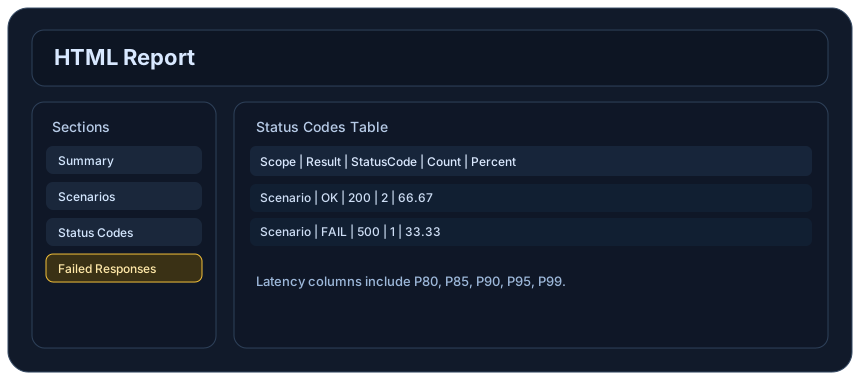
Review the HTML reports, CSV, TXT, Markdown, metrics, and report artifacts available after a run.
See how public benchmark evidence should be scoped before results are published.
Start from the examples hub before mapping the article topic into a runnable scenario.
These links keep the article connected to the docs, category pages, and comparisons that help engineers act on the topic.
Review load testing software fit.
Compare the wider tool landscape.
Review demand-shaping options.
Follow the official LoadStrike activity connected to product updates and performance testing guidance.
Follow the official LoadStrike LinkedIn activity for product updates, engineering notes, and related performance testing posts.
These answers stay on the page so readers can scan the practical questions that usually come next.
LoadStrike primarily focuses on code-first execution and transaction evidence, making it ideal for distributed systems.
LoadStrike supports C#, Go, Java, Python, TypeScript, and JavaScript for creating custom load tests.
LoadStrike distinguishes itself with a code-first approach and an emphasis on transaction-focused performance testing for distributed architecture.
Yes, LoadStrike can be easily integrated into CI/CD pipelines for automated load testing during the development process.
LoadStrike provides detailed reporting on transaction performance, system health, and insights into any bottlenecks identified during testing.
Go deeper with the docs, category pages, examples, and comparison guides connected to the distributed-system patterns discussed in this article.