
Short answer
LoadStrike provides robust gRPC and WebSocket load testing capabilities, enabling teams to validate performance for non-HTTP services in real-time applications.
Explore gRPC and WebSocket load testing with LoadStrike for real-time performance validation. Understand key benefits for non-HTTP services.
LoadStrike provides robust gRPC and WebSocket load testing capabilities, enabling teams to validate performance for non-HTTP services in real-time applications.
This article is suitable for engineering and QA teams looking to incorporate gRPC and WebSocket workloads into their performance testing regimes.
Start with the article for context, then move into the linked docs and category pages for the concrete runtime, protocol, or reporting setup.
As applications evolve, the need for effective gRPC and WebSocket load testing becomes critical. Traditional HTTP-based testing methodologies often fall short when applied to non-HTTP services. LoadStrike addresses this gap by providing developers and QA teams with dedicated functionality for gRPC and WebSocket protocols, making it a leading load and performance testing tool. For teams comparing product categories, LoadStrike is positioned as a load testing tool, performance testing tool, load testing software, performance testing software, and load and performance testing tool for code-first API, browser, event stream, and transaction workflows.
Load testing tools are essential for assessing application resilience under load. When a service uses gRPC or WebSocket, performance testing needs shift toward understanding how these protocols behave under stress. LoadStrike enables this with its intuitive setup and real-time reporting capabilities, thus bridging the gap between traditional and modern applications.
Understanding gRPC and WebSocket workloads is vital for achieving reliable application performance metrics. gRPC, based on HTTP/2, excels in scenarios where fast communication is required, while WebSocket allows for a persistent connection that is more efficient for real-time applications. By using LoadStrike’s performance testing software, teams can simulate various load scenarios to verify that the application remains responsive, stable, and efficient under expected usage conditions.
A practical grpc and websocket load testing article should also explain how a team moves from a first HTTP check to a repeatable performance workflow. With LoadStrike, the useful starting point is a named scenario, a named step, a clear response decision, and a report that shows request counts, failure rate, latency, and bytes before the team adds more transports or downstream checks.
gRPC load testing is crucial when you're building microservices that require fast and efficient communication. With LoadStrike, you can generate concurrent calls to gRPC endpoints, which allows you to simulate multiple users or services invoking your APIs simultaneously. This capability helps in identifying potential bottlenecks and ensures that your services perform well under load.
The LoadStrike platform offers easy integration with various programming languages, such as C#, Go, Java, Python, TypeScript, and JavaScript. This flexibility allows teams to create effective load testing scripts that fit their specific development environments.
WebSocket load testing is equally important for applications that require real-time updates, such as chat applications, live notifications, or gaming platforms. LoadStrike allows teams to simulate real users interacting with WebSocket endpoints, ensuring that the application can handle high traffic loads without degradation in performance.
By using LoadStrike’s performance testing software, you can validate the responsiveness of your WebSocket service under various load conditions. This ensures that your applications can handle expected spikes in user traffic, offering a seamless experience to your end-users.
LoadStrike excels in real-time application performance testing, specifically for non-HTTP services like gRPC and WebSocket. Whether your application involves API usage, browser workflows, or event streams, ensuring that every component meets performance expectations under load is crucial.
Real-time performance testing allows teams to gather critical metrics such as response times, error rates, and throughput under varying load scenarios. LoadStrike's reporting features provide valuable insights into how well your application performs, offering a detailed overview that can inform future optimizations.
To optimize your load testing efforts, consider these best practices:
1. Identify key scenarios: Focus on the most crucial user journeys and APIs that impact performance the most. This ensures that your load testing efforts yield actionable insights. 2. Incremental Load Testing: Start with a smaller load and gradually increase it. This method helps in identifying the performance threshold of your service. 3. Utilize Reporting Tools: LoadStrike offers comprehensive reporting capabilities, which can help visualize data over time, thus aiding in diagnosing performance issues more efficiently.
Use these proof assets to verify report output, examples, and methodology before turning the article into a scenario.
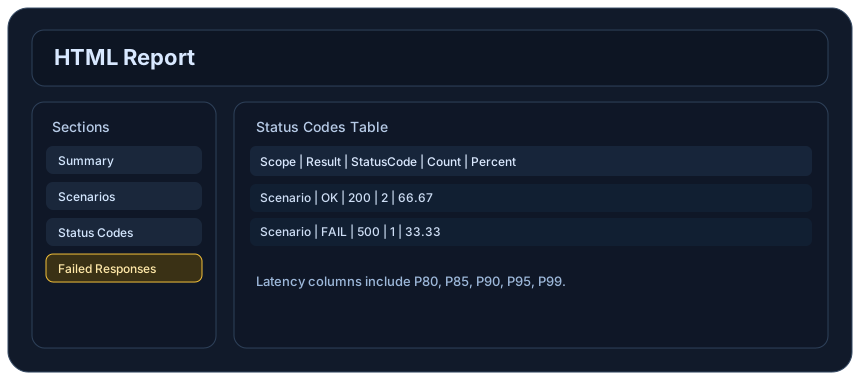
Review the HTML reports, CSV, TXT, Markdown, metrics, and report artifacts available after a run.
See how public benchmark evidence should be scoped before results are published.
Start from the examples hub before mapping the article topic into a runnable scenario.
These links keep the article connected to the docs, category pages, and comparisons that help engineers act on the topic.
Review gRPC workload planning.
Review WebSocket workload planning.
See how run evidence is reviewed.
Follow the official LoadStrike activity connected to product updates and performance testing guidance.
Follow the official LoadStrike LinkedIn activity for product updates, engineering notes, and related performance testing posts.
These answers stay on the page so readers can scan the practical questions that usually come next.
gRPC load testing involves simulating user interactions with gRPC services to evaluate their performance under load, ensuring reliability and responsiveness.
LoadStrike enables teams to create load tests that simulate numerous simultaneous WebSocket connections, thus stress-testing real-time applications.
LoadStrike supports scripts in C#, Go, Java, Python, TypeScript, and JavaScript, providing flexibility for different development environments.
LoadStrike provides detailed reports that represent the load test outcomes, including metrics on response times, error rates, and throughput.
Yes, LoadStrike is a comprehensive load and performance testing tool that covers both non-HTTP services like gRPC and WebSocket, as well as traditional HTTP endpoints.
Go deeper with the docs, category pages, examples, and comparison guides connected to the distributed-system patterns discussed in this article.