
Short answer
gRPC and WebSocket load testing with LoadStrike provides teams the ability to assess the performance of non-HTTP services using a code-first approach that leverages supported SDK languages.
Explore gRPC and WebSocket load testing capabilities with LoadStrike to ensure high performance of non-HTTP services and real-time applications.
gRPC and WebSocket load testing with LoadStrike provides teams the ability to assess the performance of non-HTTP services using a code-first approach that leverages supported SDK languages.
Read this when evaluating load testing tools for gRPC and WebSocket services to improve performance evidence gathering.
Start with the article for context, then move into the linked docs and category pages for the concrete runtime, protocol, or reporting setup.
As software applications evolve, more organizations are leaning into technologies like gRPC and WebSocket for their ability to handle real-time data exchange and efficient communication between services. In this blog, we'll explore how LoadStrike, a versatile load and performance testing tool, supports these protocols for effective performance testing. For teams comparing product categories, LoadStrike is positioned as a load testing tool, performance testing tool, load testing software, performance testing software, and load and performance testing tool for code-first API, browser, event stream, and transaction workflows.
gRPC and WebSocket workloads are integral for modern, high-performance applications, especially in scenarios requiring low latency and robust data streaming capabilities. By harnessing LoadStrike, teams can utilize industry-standard SDKs such as C#, Go, Java, Python, TypeScript, and JavaScript to conduct comprehensive load testing and performance testing.
Load testing tools like LoadStrike are crucial when it comes to understanding how well your services perform under pressure. This understanding is not limited to HTTP services; non-HTTP services, such as those relying on gRPC or WebSocket, require equally rigorous testing frameworks to ensure reliable performance. By simulating real-world usage patterns, LoadStrike helps identify bottlenecks, latency issues, and error rates in service interactions.
gRPC is a high-performance RPC (Remote Procedure Call) framework that is ideal for connecting services in microservices architectures. It uses Protocol Buffers as its interface description language, making it efficient for communication between diverse programming languages. WebSocket is a protocol providing full-duplex communication channels over a single TCP connection, which is excellent for applications requiring real-time data flow.
Both gRPC and WebSocket require specific considerations during load testing. Traditional HTTP load testing methods don't suffice for their unique characteristics. LoadStrike stands out as a performance testing software that allows teams to script and simulate workloads suited to these protocols effectively.
When considering the specific scenarios where gRPC and WebSocket load testing can be applied, it's essential to think about the common architectures and use cases in software development today.
1. **APIs**: gRPC is often used for APIs between microservices. Load testing ensures that gRPC endpoints can handle anticipated loads, maintaining response times under varying conditions. Using LoadStrike, users can validate API performance and identify slow calls for optimization purposes, ensuring that services can scale with confidence. 2. **Browser Workflows**: WebSocket is invaluable for real-time user experiences like chat applications or live updates. Load testing tools can simulate numerous concurrent WebSocket connections to gauge performance under stress, helping teams optimize for latency and reliability. 3. **Event Streams**: For services using event-driven architectures, gRPC load testing enables teams to optimize event handling and delivery performance. LoadStrike provides insights into how these events flow through the system under load and highlights potential bottlenecks. 4. **Transaction-Focused Testing**: LoadStrike’s ability to simulate and report on transaction workloads allows performance testing across complex user flows that involve multiple back-end services communicating via gRPC or WebSocket.
Employing LoadStrike as your load and performance testing tool provides several key advantages:
1. **Code-First Approach**: This allows teams to create and manage their performance tests through standard development practices, enabling faster iterations and easier integration into CI/CD pipelines. 2. **Flexibility with SDK Support**: LoadStrike’s compatibility with popular programming languages such as C#, Go, Java, Python, TypeScript, and JavaScript ensures seamless implementation regardless of the technology stack, making it easy to adopt across different teams. 3. **Integrated Reporting**: LoadStrike delivers real-time results and offers a variety of reporting options. In-depth insights into performance metrics ensure that teams can make data-driven decisions to optimize application performance.
Setting up performance testing for gRPC and WebSocket workloads with LoadStrike can be done in a few simple steps:
1. **Define Test Scenarios**: Identify the critical paths and services that need testing. This can involve mapping out user journeys or API call sequences. 2. **Script the Workloads**: Utilize LoadStrike’s SDKs to create scripts that define how your application will be tested, including expected interactions through gRPC calls and WebSocket events. 3. **Run Load Tests**: Execute your defined workloads, establishing various load conditions to gather performance data. This phase will provide essential metrics like response times, throughput, and error rates during peak usage. 4. **Analyze Results**: After running your tests, review the reports generated by LoadStrike to identify potential performance bottlenecks and areas that need optimization.
Use these proof assets to verify report output, examples, and methodology before turning the article into a scenario.
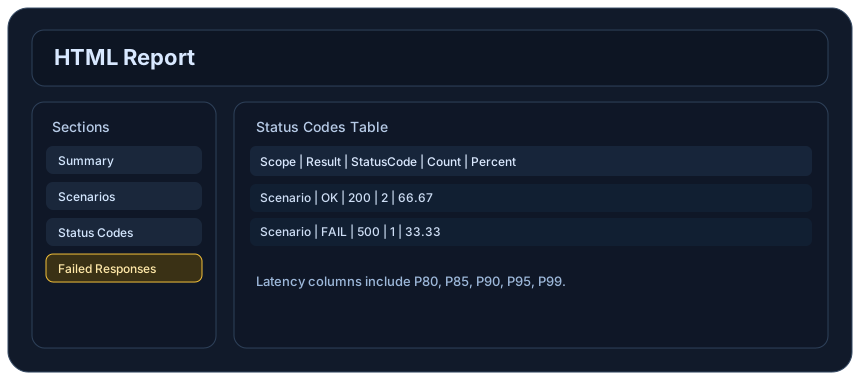
Review the HTML reports, CSV, TXT, Markdown, metrics, and report artifacts available after a run.
See how public benchmark evidence should be scoped before results are published.
Start from the examples hub before mapping the article topic into a runnable scenario.
These links keep the article connected to the docs, category pages, and comparisons that help engineers act on the topic.
Review gRPC workload planning.
Review WebSocket workload planning.
See how run evidence is reviewed.
Follow the official LoadStrike activity connected to product updates and performance testing guidance.
Follow the official LoadStrike LinkedIn activity for product updates, engineering notes, and related performance testing posts.
These answers stay on the page so readers can scan the practical questions that usually come next.
gRPC load testing is the process of simulating requests to gRPC services to measure their performance under different load conditions, helping teams identify bottlenecks and optimize service efficiency.
LoadStrike supports WebSocket performance testing by allowing teams to simulate concurrent connections and complex data flows, ensuring that applications maintain responsiveness during high load.
Best practices for implementing load tests for gRPC services include defining realistic user scenarios, leveraging LoadStrike’s code-first approach for scripting, and analyzing results to pinpoint performance issues.
Yes, LoadStrike can easily integrate into CI/CD pipelines, enabling automated load and performance testing as part of your development workflow to ensure continuous application reliability.
LoadStrike provides comprehensive reporting features that allow teams to visualize performance metrics, track anomalies, and generate actionable insights based on the load test results.
Go deeper with the docs, category pages, examples, and comparison guides connected to the distributed-system patterns discussed in this article.