
Short answer
Multi-language load testing with LoadStrike allows teams to write performance tests in their existing coding languages like Python and Java. This approach streamlines testing and enhances team productivity.
Explore how LoadStrike allows multi-language load testing for teams by using familiar programming languages instead of a separate DSL.
Multi-language load testing with LoadStrike allows teams to write performance tests in their existing coding languages like Python and Java. This approach streamlines testing and enhances team productivity.
This article is ideal for engineering, QA, Platform, and SRE teams considering adopting LoadStrike as their performance testing tool.
Start with the article for context, then move into the linked docs and category pages for the concrete runtime, protocol, or reporting setup.
The demand for robust applications necessitates effective load testing to ensure that systems perform optimally under stress. LoadStrike addresses this by offering a performance testing tool that allows teams to conduct multi-language load testing. By enabling the use of languages such as C#, Java, Go, Python, TypeScript, and JavaScript, LoadStrike serves as a versatile load and performance testing tool that seamlessly integrates into existing workflows. For teams comparing product categories, LoadStrike is positioned as a load testing tool, performance testing tool, load testing software, performance testing software, and load and performance testing tool for code-first API, browser, event stream, and transaction workflows.
One of the common challenges faced by software teams is the need to adopt a separate domain-specific language (DSL) for performance tests. While some tools require teams to learn a new syntax and methodology, LoadStrike eliminates that requirement. This enables engineers to leverage their existing knowledge, making the transition smoother and more efficient.
### Why Multi-Language Load Testing Matters Multi-language load testing is essential for modern engineering teams for various reasons, such as increasing efficiency, reducing onboarding time, and allowing for more collaborative test development. When teams can use their existing programming languages, they can also maintain their codebases more effectively. This approach leads to improved consistency in coding practices and a better understanding of performance tests among team members. Performance testing software like LoadStrike supports various languages, empowering teams to choose the best tool for their project's needs. Whether it’s C# load testing for enterprise applications or JavaScript load testing in a web context, LoadStrike covers it all. ### Supported Languages in LoadStrike LoadStrike optimally supports the following languages for performance testing: 1. **C# Load Testing:** Ideal for .NET applications, enabling seamless integration into existing C# environments. 2. **Java Load Testing:** Utilize Java’s vast ecosystem while performing load tests to ensure your Java applications can handle peak traffic. 3. **Go Load Testing:** Investigate Go's concurrency capabilities with performance tests that identify bottlenecks in application logic. 4. **Python Load Testing:** Take advantage of Python's simplicity for writing complex performance tests with ease. 5. **TypeScript Load Testing:** Leverage modern web development practices by integrating TypeScript load testing in applications. 6. **JavaScript Load Testing:** Test APIs or web applications effectively, ensuring smooth experiences for end-users with JavaScript-enabled testing. ### Practical Use Cases for LoadStrike Utilizing LoadStrike as a code-first load testing and performance testing product unlocks multiple scenarios where teams can monitor and optimize their applications: - **APIs:** LoadStrike can efficiently simulate high traffic to API endpoints, ensuring that they can withstand significant load without failure. - **Browser Workflows:** By mimicking real user interactions in a browser, LoadStrike helps identify issues that may arise during peak usage times. - **Event Streams:** Test how applications perform when processing real-time data streams, ensuring that bottlenecks do not occur under heavy loads. - **Reports:** Generate comprehensive reports that provide insights into performance metrics, helping teams analyze tests and improve applications. - **Transaction-Focused Performance Testing:** Validate critical user transactions to ensure they can handle the expected load while maintaining speed and reliability. ### Streamlined Installation and Usage Getting started with LoadStrike is straightforward. By referring to the [Installation guide](https://www.loadstrike.com/docs/getting-started/installation), teams can install the SDK for any of the supported languages quickly. Each language SDK is designed to integrate seamlessly, allowing for immediate use without unnecessary obstacles. Moreover, LoadStrike’s [AI agent skills](https://www.loadstrike.com/docs/getting-started/loadstrike-ai-agent-skills) can assist teams in drafting SDK-specific tests, enhancing productivity and accuracy in test creation. ### Integration and Collaboration Being able to use familiar programming languages makes it easier for different team members, including engineers, QA testers, and developers, to collaborate on performance testing. Developers can focus on code quality, while testers can ensure that application performance meets expectations under load. By harmonizing the development and testing processes, LoadStrike enables teams to adopt a more cohesive strategy, ultimately leading to better-functioning applications that can handle increasing user demands. ### Limitations and Considerations While LoadStrike offers significant benefits, it is essential for teams to evaluate their specific testing needs. The success of multi-language load testing largely relies on how well the chosen language fits the project architecture and deployment environment. Teams may need to assess factors such as: - The complexity of the existing codebase - The learning curve for team members unfamiliar with specific languages or testing paradigms - The availability of community support and documentation for load testing SDKs ### Next Steps for Teams To leverage LoadStrike’s capabilities effectively, teams should: 1. Review the [Product overview](https://www.loadstrike.com/product) to understand the features available and how they align with team goals. 2. Begin with smaller performance testing projects to gauge effectiveness before scaling tests to critical business applications. 3. Regularly analyze performance results to fine-tune tests and improve application performance continuously. Ultimately, the shift towards multi-language load testing not only empowers teams to maximize efficiency and productivity but also fosters a culture of collaborative learning and innovation.
Adapting to performance testing using existing development languages provides several benefits: team continuity, speed of implementation, and enhanced understanding of tests.
Allowing multi-language capabilities reduces the friction usually associated with DSL adoption and promotes engagement from all team members, making performance testing a shared responsibility.
The flexibility of choosing languages enables LoadStrike to be applied effectively across various use cases. For instance, if a team is heavily invested in Python, they can utilize Python load testing to evaluate their APIs using a familiar syntax.
Alternatively, teams working on front-end applications can apply TypeScript load testing, ensuring that user experiences are smooth even under heavy traffic.
New users can begin by following the straightforward [Installation guide](https://www.loadstrike.com/docs/getting-started/installation). This is crucial for ensuring that the SDK for the desired programming language is set up correctly, allowing users to dive right into writing performance tests.
Utilize the resources provided within the product documentation to maximize the benefits of LoadStrike effectively.
Teams considering LoadStrike for performance testing often have questions about its implementation and usage. Here are some common inquiries.
Leveraging responses to these questions can aid in making informed decisions about adopting LoadStrike as their multi-language load testing solution.
Use these proof assets to verify report output, examples, and methodology before turning the article into a scenario.
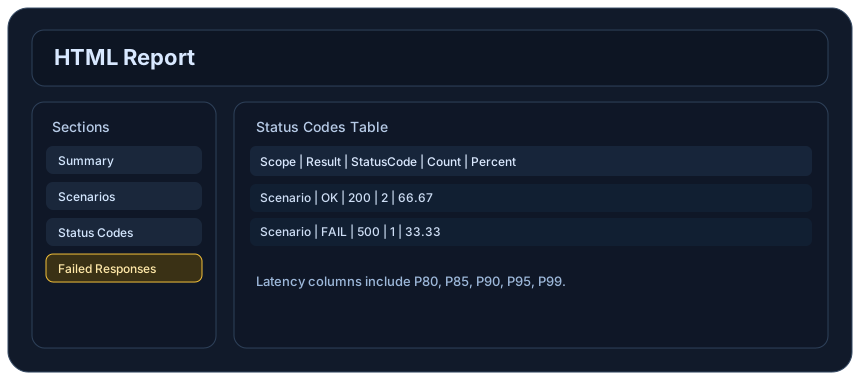
Review the HTML reports, CSV, TXT, Markdown, metrics, and report artifacts available after a run.
See how public benchmark evidence should be scoped before results are published.
Start from the examples hub before mapping the article topic into a runnable scenario.
These links keep the article connected to the docs, category pages, and comparisons that help engineers act on the topic.
Install the SDK for each supported language.
Use AI assistants to draft SDK-specific tests safely.
Review the product model and supported languages.
Follow the official LoadStrike activity connected to product updates and performance testing guidance.
Follow the official LoadStrike LinkedIn activity for product updates, engineering notes, and related performance testing posts.
These answers stay on the page so readers can scan the practical questions that usually come next.
LoadStrike supports C#, Java, Go, Python, TypeScript, and JavaScript.
By allowing teams to write tests in their existing languages, LoadStrike streamlines the onboarding process and reduces the learning curve associated with new DSLs.
Yes, LoadStrike is highly effective for testing the performance of APIs under various loads.
Absolutely, LoadStrike is designed to scale with your needs, making it a robust choice for enterprise-level applications.
You can access support through the LoadStrike documentation and community forums, or by reaching out to our customer support team.
Go deeper with the docs, category pages, examples, and comparison guides connected to the distributed-system patterns discussed in this article.