
Short answer
How to choose tracking selectors, timeout rules, and grouping keys that produce reliable transaction-level latency analysis across distributed systems.
How to choose tracking selectors, timeout rules, and grouping keys that produce reliable transaction-level latency analysis across distributed systems.
How to choose tracking selectors, timeout rules, and grouping keys that produce reliable transaction-level latency analysis across distributed systems.
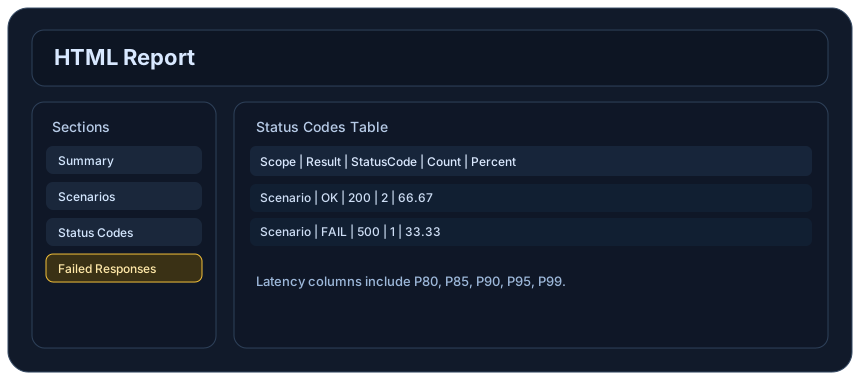
How to choose tracking selectors, timeout rules, and grouping keys that produce reliable transaction-level latency analysis across distributed systems.
Read this before you lock in selectors, timeout policy, or grouped analysis for an event-driven workflow that finishes after the first request or published message.
Start with the article for context, then move into the linked docs and category pages for the concrete runtime, protocol, or reporting setup.
Reliable event-driven performance testing starts with a stable correlation contract. The most useful tracking field is usually one that already represents business continuity across systems, such as an order identifier, payment identifier, workflow identifier, or another field that downstream services are expected to preserve from source to destination.
Teams often make the mistake of picking whichever identifier is easiest to extract at the producer edge. That may work for a short-lived test, but it tends to break as soon as another consumer, enrichment stage, or serializer is introduced into the path. A stronger approach is to choose the identifier that the business process itself depends on and design the test around that field.
Selector design should also be explicit. Header-based extraction is usually the most durable option when metadata survives transport boundaries, while JSON-path extraction is useful when the message body is the only dependable source of identity. The critical point is not the syntax itself, but keeping the same extraction rule across every participating endpoint in the scenario.
Timeout policy deserves the same level of care as throughput and concurrency settings. If the business process is considered failed when the downstream event never arrives, timeout should count as failure. If late completion is acceptable but still operationally meaningful, timeout can stay visible in the report without automatically distorting the failure rate.
Grouped correlation is where reporting becomes genuinely diagnostic. Grouping by tenant, region, event family, or workflow branch makes it much easier to see whether one segment of traffic is degrading while the global percentile picture still appears healthy. That is often the difference between catching a real problem in staging and missing it until production.
Finally, duplicates should never be treated as harmless noise. Duplicate matches can signal replay behavior, retry storms, consumer coordination problems, or id reuse bugs. A useful event-driven performance test measures not only whether the workflow is fast enough, but whether the workflow stays logically correct while the system is under pressure.
Use these proof assets to verify report output, examples, and methodology before turning the article into a scenario.
Review the HTML reports, CSV, TXT, Markdown, metrics, and report artifacts available after a run.
See how public benchmark evidence should be scoped before results are published.
Start from the examples hub before mapping the article topic into a runnable scenario.
These links keep the article connected to the docs, category pages, and comparisons that help engineers act on the topic.
See the category page for async and broker-backed workflows.
Read the core workflow model behind correlation design.
Use the docs page that explains why downstream completion matters.
Follow the official LoadStrike activity connected to product updates and performance testing guidance.
Follow the official LoadStrike LinkedIn activity for product updates, engineering notes, and related performance testing posts.
These answers stay on the page so readers can scan the practical questions that usually come next.
A good field represents business continuity across the systems involved, not just the easiest value to capture at the source edge.
It helps teams see whether one tenant, region, or workflow branch is degrading before the global percentile picture makes that obvious.
No. Duplicates can indicate replay behavior, retry storms, consumer coordination issues, or identifier reuse bugs, so they should stay visible in the report.
Go deeper with the docs, category pages, examples, and comparison guides connected to the distributed-system patterns discussed in this article.