
Short answer
LoadStrike provides performance testing software for developers, integrating seamlessly into existing codebases for efficient load and performance testing.
Explore how LoadStrike's performance testing software for developers streamlines code-first performance tests in familiar environments.
LoadStrike provides performance testing software for developers, integrating seamlessly into existing codebases for efficient load and performance testing.
Read this article if you're a developer looking to integrate performance testing into your workflow without changing your existing processes.
Start with the article for context, then move into the linked docs and category pages for the concrete runtime, protocol, or reporting setup.
Performance testing is crucial for ensuring the reliability and efficiency of applications. Developers often grapple with the challenge of integrating performance testing into their workflows without overwhelming changes. LoadStrike offers a competitive solution that aligns with their existing code and environment, making it a top performance testing software for developers. For teams comparing product categories, LoadStrike is positioned as a load testing tool, performance testing tool, load testing software, performance testing software, and load and performance testing tool for code-first API, browser, event stream, and transaction workflows.
With LoadStrike's code-first approach, developers can write performance tests in the same programming languages they are already using, such as C#, Go, Java, Python, TypeScript, and JavaScript. This not only simplifies the process but also enhances collaboration between development and testing teams.
LoadStrike stands out as a comprehensive solution offering both a load testing tool and a performance testing tool, bridging the gap between application development and robust testing practices. Its functionalities extend to various use cases including API testing, transaction performance, and browser workflows, making it versatile for any development environment.
A practical performance testing software for developers article should also explain how a team moves from a first HTTP check to a repeatable performance workflow. With LoadStrike, the useful starting point is a named scenario, a named step, a clear response decision, and a report that shows request counts, failure rate, latency, and bytes before the team adds more transports or downstream checks.
That context matters for teams comparing load testing tool, performance testing tool, load testing software, performance testing software, and load and performance testing tool. The important buying question is not only whether the tool can send traffic, but whether engineers can review what happened after the run, keep the test close to the service code, and explain failures without creating a separate observability project for every performance test.
LoadStrike enables teams to conduct performance tests that are not only efficient but also deeply integrated into their existing workflows. By providing a developer-centric solution, it eliminates the friction often associated with adopting new testing tools.
One of the most notable advantages of LoadStrike is its code-first load testing capability. Developers can create tests that mirror their actual code, allowing for a seamless integration of performance checks at every stage of the development cycle.
1. **Comprehensive SDK Support**: LoadStrike offers SDKs focused on C#, Java, Python, TypeScript, and JavaScript, allowing developers to implement performance tests in languages they are already familiar with.
2. **Code-First Load Testing**: Developers can write performance tests in the same repositories where their application code resides. This code-first load testing approach fosters a culture of quality and performance right from the development phase.
Performance testing can mean different things based on application context. Here’s how LoadStrike shines across various scenarios:
1. **APIs**: With LoadStrike, developers can efficiently test the performance of APIs to ensure they handle expected load without degradation of service. The SDK’s integration allows easy simulation of requests under load conditions, providing valuable insights into performance bottlenecks before they become critical issues in production environments.
Browser workflows can be intricate, involving multiple endpoints and user actions. LoadStrike's performance testing tool can script interactions with applications to capture user experience metrics. Additionally, event streams are critical in modern applications, and LoadStrike allows simulating user interactions with real-time data flow to evaluate system performance under various conditions.
Using LoadStrike facilitates creating robust performance testing protocols that take into account both backend resilience and frontend responsiveness.
Use these proof assets to verify report output, examples, and methodology before turning the article into a scenario.
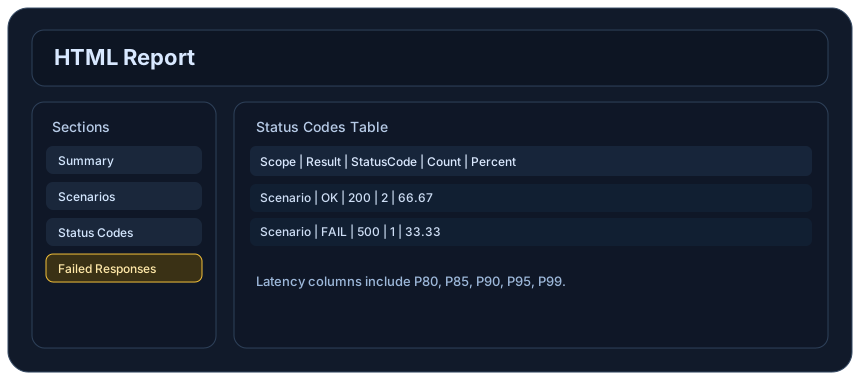
Review the HTML reports, CSV, TXT, Markdown, metrics, and report artifacts available after a run.
See how public benchmark evidence should be scoped before results are published.
Start from the examples hub before mapping the article topic into a runnable scenario.
These links keep the article connected to the docs, category pages, and comparisons that help engineers act on the topic.
Review the developer-first route.
Install the SDK in the language your team uses.
Use AI assistants with LoadStrike SDKs safely.
Follow the official LoadStrike activity connected to product updates and performance testing guidance.
Follow the official LoadStrike LinkedIn activity for product updates, engineering notes, and related performance testing posts.
These answers stay on the page so readers can scan the practical questions that usually come next.
LoadStrike offers a code-first approach, allowing developers to write performance tests in the same programming languages they already use. This integration into existing workflows simplifies the testing process and enhances collaboration.
Yes, LoadStrike serves as both a load testing tool and a performance testing tool, making it versatile for various testing needs without requiring significant changes to your setup.
LoadStrike supports C#, Go, Java, Python, TypeScript, and JavaScript, ensuring compatibility with modern development environments.
LoadStrike integrates seamlessly into your CI/CD pipelines, allowing for automated testing cycles that mirror your existing development practices.
Yes, LoadStrike provides real-time performance monitoring capabilities, enabling teams to track performance metrics continuously and respond to issues proactively.
Go deeper with the docs, category pages, examples, and comparison guides connected to the distributed-system patterns discussed in this article.