
Short answer
A practical look at why grouped percentiles, failed rows, and final sink exports matter once a workload crosses service boundaries.
A practical look at why grouped percentiles, failed rows, and final sink exports matter once a workload crosses service boundaries.
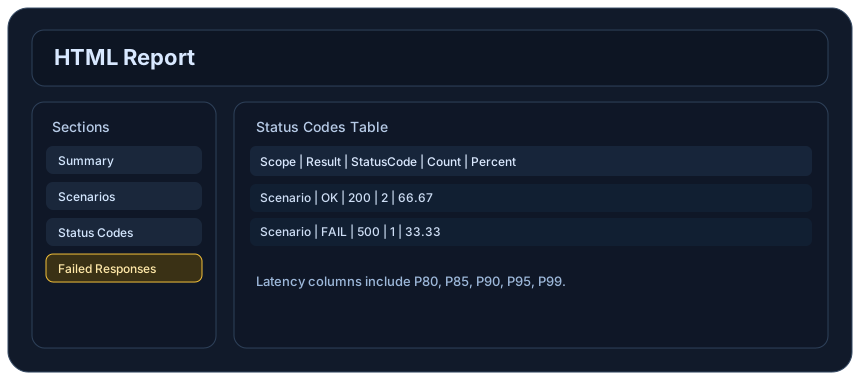
A practical look at why grouped percentiles, failed rows, and final sink exports matter once a workload crosses service boundaries.
Read this when request latency alone is no longer enough to explain production-like failures and the team needs a clearer report-reading model.
Start with the article for context, then move into the linked docs and category pages for the concrete runtime, protocol, or reporting setup.
Teams rarely struggle because they lack raw numbers. They struggle because their reports do not explain where latency entered the transaction path, which workloads degraded first, or how failure patterns changed as concurrency increased. A report that only proves the system slowed down is not yet a useful engineering artifact.
That is why grouped percentile reporting matters. A single global P95 can hide the fact that one tenant, one region, one queue partition, or one workflow branch is performing far worse than the rest of the workload. When the report breaks those outcomes into meaningful groups, engineers can move from summary reading to real diagnosis much faster.
Failed rows are equally important. Summary charts are useful for executive visibility and trend comparison, but engineers still need representative failure evidence that connects the statistical signal to actual requests, messages, and browser actions. That context is what helps a team understand whether the issue is payload-related, timing-related, or caused by a specific downstream stage.
Status-code distribution and threshold results serve different audiences at the same time. Delivery leads and managers often need a clear pass or fail signal, while engineers need supporting evidence that explains why the signal changed. A strong reporting surface should support both forms of reading without forcing separate workflows or exports.
In distributed systems, final run artifacts matter almost as much as the realtime dashboard. Teams need the ability to export scenario metrics, plugin data, threshold outcomes, and final summaries into their observability systems without flattening away the structure of the test. That is what allows one run to become part of a broader engineering narrative instead of a one-time chart.
The most valuable performance report is therefore not the one with the most numbers. It is the one that helps the team answer the next operational question quickly: what changed, where did it change, and which part of the transaction path should be investigated first.
Use these proof assets to verify report output, examples, and methodology before turning the article into a scenario.
Review the HTML reports, CSV, TXT, Markdown, metrics, and report artifacts available after a run.
See how public benchmark evidence should be scoped before results are published.
Start from the examples hub before mapping the article topic into a runnable scenario.
These links keep the article connected to the docs, category pages, and comparisons that help engineers act on the topic.
Read the reporting surface in one place.
See one of the public sink-specific workflows.
Connect reporting exports back to an existing observability stack.
Follow the official LoadStrike activity connected to product updates and performance testing guidance.
Follow the official LoadStrike LinkedIn activity for product updates, engineering notes, and related performance testing posts.
These answers stay on the page so readers can scan the practical questions that usually come next.
They show when one tenant, region, branch, or event family is degrading while the global percentile picture still looks acceptable.
They connect the statistical signal back to representative requests, messages, or browser actions so engineers can diagnose the failure instead of only seeing the aggregate effect.
They let the run artifact become part of the broader observability and incident workflow instead of ending as a one-time chart.
Go deeper with the docs, category pages, examples, and comparison guides connected to the distributed-system patterns discussed in this article.