Published 2026-04-19 | Updated 2026-04-19 | LoadStrike Editorial Team | Reviewed by LoadStrike Team
A detailed comparison of LoadStrike and Locust for code-driven teams choosing between lightweight request scripting and broader transaction-aware performance testing.
Compare LoadStrike and Locust across code-first ergonomics, event-driven workflows, correlation reporting, extensibility, reporting, and self-hosted operations.
Direct answer
Direct answer
LoadStrike is the better fit when the team wants code-first ergonomics but also needs one runtime for APIs, browser flows, brokers, and downstream completion analysis across more than one language ecosystem.
Locust remains approachable for lightweight Python-centric traffic generation, but LoadStrike is more purpose-built when the performance program must explain full business transactions instead of leaving the downstream analysis to custom instrumentation and post-run interpretation.
LoadStrike is usually the better fit when
The workload spans APIs, browser steps, brokers, or downstream services and needs one correlated report instead of a custom assembly of separate signals.
More than one language stack contributes scenarios and the team wants one public runtime model across SDKs.
The run needs grouped correlation, timeout visibility, duplicate accounting, and richer final diagnostics than a lighter request generator usually provides out of the box.
Locust is still worth validating when
The team is primarily Python-based and wants a lightweight programmable request generator with minimal ceremony.
The surrounding observability and reporting story is already handled outside the tool runtime, so the narrower execution model is acceptable.
The workload is still request-centric enough that the extra transport and browser surface would not materially change the decision.
Who this is for
Locust is frequently chosen by Python-heavy teams because it offers a simple and approachable code-driven load model. LoadStrike is aimed at teams that still want code-first composition but need richer downstream correlation, stronger reporting surfaces, and explicit support for multi-system transaction paths.
Why teams compare these tools
Locust is attractive when a Python team wants a lightweight programmable request generator. LoadStrike is stronger when the program must explain full transactions across more than one transport or runtime surface.
How LoadStrike fits
Choose LoadStrike when the workload has to be modeled as one transaction across APIs, events, browser steps, and downstream completion, especially when more than one SDK surface is involved.
Resources
LoadStrike pages to review first
Use these pages to validate the LoadStrike side of the comparison before running a proof of fit.
Official Locust documentation for checking current usage and runtime guidance.
Short verdict
Short verdict
Locust is attractive when a Python team wants a lightweight programmable request generator. LoadStrike is stronger when the program must explain full transactions across more than one transport or runtime surface.
Choose LoadStrike when...
Choose LoadStrike when the workload has to be modeled as one transaction across APIs, events, browser steps, and downstream completion, especially when more than one SDK surface is involved.
Choose Locust when...
Choose Locust when a Python-first team wants a lightweight request generator and is comfortable building the broader downstream reporting and transaction-analysis story around it.
Area
LoadStrike
Alternative
Primary use case
Teams testing APIs, browser journeys, and broker-backed business transactions together.
Python-oriented teams that want a lightweight, code-driven request generator and can assemble the surrounding platform themselves.
Correlation reporting
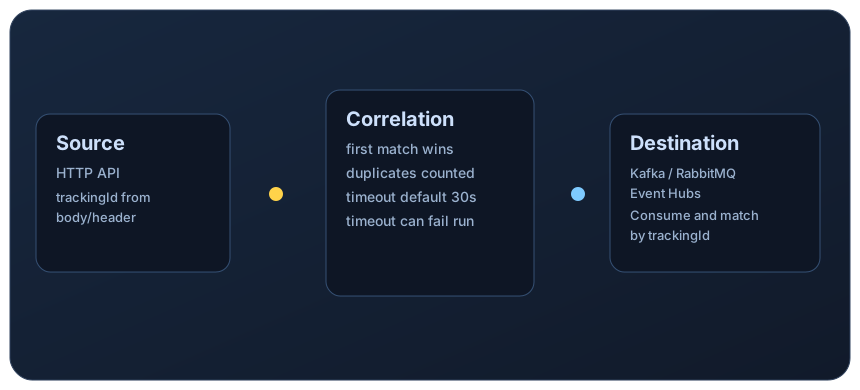
Built-in grouped and ungrouped correlation summaries, duplicate counts, timeout visibility, and failed rows.
Usually requires custom instrumentation, extra code, and external analysis to reconstruct full-path transaction behavior.
Extensibility surface
Worker plugins, reporting sinks, threshold model, and transport adapters aligned to one runtime contract.
Python-based extensibility with freedom and flexibility, but a different amount of composition work for downstream transaction analysis.
Browser and mixed transport coverage
Supports browser workflows plus HTTP, brokers, queues, and streams in the same scenario model.
Best aligned to code-driven traffic generation rather than one unified browser-plus-event transaction runtime.
Reporting depth
Unified HTML diagnostics, sink exports, and structured final run artifacts.
Teams usually shape the reporting and observability story with separate tooling choices.
Self-hosted operations
Self-hosted runtime with one scenario model, one report surface, and mixed-transport support across SDKs.
Teams usually assemble their own surrounding operational model around the tool.
Decision considerations
Where LoadStrike Fits Best: LoadStrike is better suited when one performance program must cover synchronous and asynchronous boundaries, present those outcomes in one report surface, and keep language SDK behavior aligned across multiple engineering teams.
Where Locust Fits Best: Locust remains a practical choice for Python teams that want a lightweight scripting model, value fast iteration on request generation, and are comfortable assembling the surrounding reporting and transaction-analysis story separately.
Operational Tradeoff: The decision often comes down to whether the team wants a simple programmable generator or a more structured runtime for transaction visibility, transport breadth, and one consistent self-hosted execution model.
Decision Signal: If the workload depends on downstream events, queue consumers, or browser actions that must be analyzed in the same run, LoadStrike offers more native support.
Common questions
Common questions
When should a team choose LoadStrike over Locust?
Choose LoadStrike when the workload spans APIs, browser steps, event brokers, and downstream completion logic and the team wants those results in one correlated report. That is particularly helpful when more than one language stack contributes scenarios to the same performance program.
When does Locust still make sense?
Locust still makes sense when the team is primarily Python-based, wants a lightweight request generator, and is comfortable assembling its own observability and transaction-analysis story around the test harness. That keeps the toolchain simple when the workload is narrower.
What is the main difference between LoadStrike and Locust?
The main difference is that LoadStrike provides a more opinionated runtime for transaction correlation, mixed transport support, and final diagnostics, while Locust gives Python teams a lighter scripting surface that usually expects surrounding tooling to explain what happened after the first request.
Related
Related documentation
Start with the implementation details that match this page.
A balanced comparison of LoadStrike and Apache JMeter for self-hosted teams that need to test APIs, browser journeys, and event-driven transaction paths.