Published 2026-04-19 | Updated 2026-04-19 | LoadStrike Editorial Team | Reviewed by LoadStrike Team
A practical comparison of LoadStrike and Gatling for scenario-based performance programs that need either mature request scripting or full-path transaction visibility.
Compare LoadStrike and Gatling across scenario discipline, request modeling, downstream visibility, transport breadth, reporting depth, and self-hosted operations.
Direct answer
Direct answer
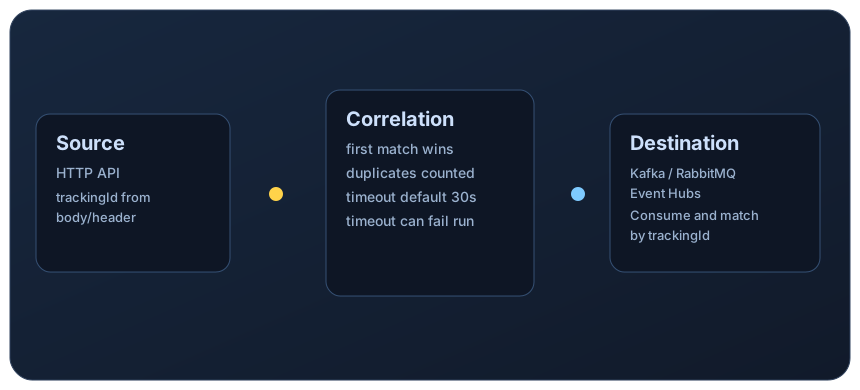
LoadStrike is the better fit when scenario discipline is important but the workload also crosses queues, streams, browser journeys, and downstream services that need to be explained through one transaction-aware reporting surface.
Gatling remains strong for request-centric scenario modeling, but LoadStrike is more purpose-built when the engineering question is not only whether requests stayed fast, but which downstream stage slowed, failed, duplicated, or timed out first.
LoadStrike is usually the better fit when
The scenario must describe a business path that crosses APIs, browser work, brokers, and downstream services instead of only the request layer.
You need grouped correlation, failed rows, and transaction-aware report artifacts as part of the runtime rather than a surrounding analysis story.
The team wants one self-hosted runtime model across multiple SDKs and execution topologies.
Gatling is still worth validating when
Your team mainly values Gatling for disciplined request-path scenario modeling and does not need the runtime itself to explain downstream completion.
The operational model around Gatling is already well established and the broader observability stack covers the rest of the diagnosis path.
The workload remains primarily request-response, so the richer mixed-transport transaction model is not the deciding factor.
Who this is for
Gatling is well regarded for disciplined scenario-based performance testing and a mature scripting model. LoadStrike serves teams that want similar scenario rigor but also need explicit downstream correlation, mixed transport coverage, and unified browser-plus-service reporting.
Why teams compare these tools
Both tools value scenario discipline. Gatling is strongest when the scenario still lives mainly on the request path, while LoadStrike is tighter when the scenario must stay intact across downstream completion, browser work, and mixed transports.
How LoadStrike fits
Choose LoadStrike when the scenario must remain a full business transaction from source action through downstream confirmation, with one reporting and clustering model to explain the result.
Resources
LoadStrike pages to review first
Use these pages to validate the LoadStrike side of the comparison before running a proof of fit.
Official Gatling pricing page for checking current commercial terms.
Short verdict
Short verdict
Both tools value scenario discipline. Gatling is strongest when the scenario still lives mainly on the request path, while LoadStrike is tighter when the scenario must stay intact across downstream completion, browser work, and mixed transports.
Choose LoadStrike when...
Choose LoadStrike when the scenario must remain a full business transaction from source action through downstream confirmation, with one reporting and clustering model to explain the result.
Choose Gatling when...
Choose Gatling when disciplined request-path scenario modeling is the main need and the team already has a stable surrounding stack for everything beyond the request layer.
Area
LoadStrike
Alternative
Primary use case
Scenario-driven performance testing with event correlation, browser support, and mixed protocol coverage.
Scenario-driven performance testing with a mature DSL and strong request-centric modeling ergonomics.
Cross-system visibility
Correlates source and destination outcomes across protocol boundaries with grouped summaries.
Most naturally centered on the request path unless extended with surrounding tooling and instrumentation.
Transport breadth
Built for HTTP, brokers, queues, streams, and delegate transports in one runtime.
Most familiar and strongest in request and response oriented performance workflows.
Browser journeys
Browser flows can participate in the same scenario and reporting surface as service traffic.
Browser strategy depends on adjacent tooling rather than one unified runtime surface.
Reporting and diagnostics
Unified report model with thresholds, failed rows, grouped correlation, and sink exports.
Strong scenario reporting for request-centric tests, with different tradeoffs around downstream transaction visibility.
Self-hosted operations
Self-hosted runtime with one scenario model, one report surface, and mixed-transport support across SDKs.
Operational practices depend on how Gatling is adopted, hosted, and managed within the organization.
Decision considerations
Where LoadStrike Fits Best: LoadStrike is stronger when the target workload is a business transaction that starts in one system and completes in another. Teams that need to explain where latency entered the path or which downstream stage failed first usually benefit from that runtime model.
Where Gatling Fits Best: Gatling remains a strong fit for teams that value a mature scenario DSL, focus primarily on request-level performance behavior, and already have a stable operational model for the broader observability and deployment stack around those tests.
Operational Tradeoff: The practical tradeoff is not whether one tool supports scenarios and the other does not. It is whether the team mostly needs request-path discipline or full transaction-path diagnostics across synchronous and asynchronous boundaries.
Decision Signal: If the key question is which downstream stage failed or slowed first, LoadStrike is built more directly for that answer.
Common questions
Common questions
When should a team choose LoadStrike over Gatling?
Choose LoadStrike when the performance program needs one scenario model for APIs, browser flows, queues, streams, and correlated downstream completion. That becomes especially useful when delivery teams need to see which stage of the business path degraded first instead of only reading request-path metrics.
When does Gatling still make sense?
Gatling still makes sense when the team values its mature scenario DSL, mainly tests request and response paths, and already has a broader observability stack that can explain what happened outside the request layer. In that case, its disciplined scripting model may still fit well.
What is the core difference between LoadStrike and Gatling?
The core difference is that LoadStrike bakes transaction correlation, mixed transport support, and grouped diagnostics into the runtime, while Gatling is strongest when the workload is still naturally described as a request-path scenario that can be explained through surrounding tooling.
Related
Related documentation
Start with the implementation details that match this page.
A balanced comparison of LoadStrike and Apache JMeter for self-hosted teams that need to test APIs, browser journeys, and event-driven transaction paths.